
In our modern era of “desk-bound” careers and constant smartphone usage, our physical foundations are under siege. Achieving proper spine alignment is no longer just a concern for athletes or the elderly; it is a critical survival skill for the digital age. This guide provides a comprehensive roadmap to restructuring your posture, alleviating chronic pain, and unlocking a level of vitality you may have thought was lost forever.
The Silent Architecture of Wellness
Your spine is more than just a stack of bones; it is the superhighway of your central nervous system. When you maintain optimal spine alignment, every organ, muscle, and nerve in your body operates with less resistance. Conversely, even a minor misalignment can lead to a “domino effect” of fatigue, digestive issues, and debilitating back pain.
To achieve a truly pain-free life, we must look at spine alignment through a multi-dimensional lens—addressing biology, ergonomics, and daily habits.
Strategy 1: The Biomechanics of the Neutral Spine
The first pillar of spine alignment is understanding the “Neutral Spine” position. Many people mistakenly believe that a straight spine is a healthy one. In reality, a healthy spine possesses three natural curves: the cervical (neck), thoracic (mid-back), and lumbar (lower back).
The “S-Curve” Mastery
To find your neutral spine alignment, imagine a plumb line dropping from your earlobe, through your shoulder, hip, and ankle. When these points are stacked, the vertical load on your intervertebral discs is minimized. This position allows your core to engage naturally, acting as a built-in “back brace” that prevents the micro-traumas leading to herniated discs.
Strategy 2: Ergonomic Engineering for the Modern Worker
For the busy professional, spine alignment is often lost in the office chair. If you sit for more than six hours a day, your environment is likely your biggest enemy.
The “90-Degree” Rule
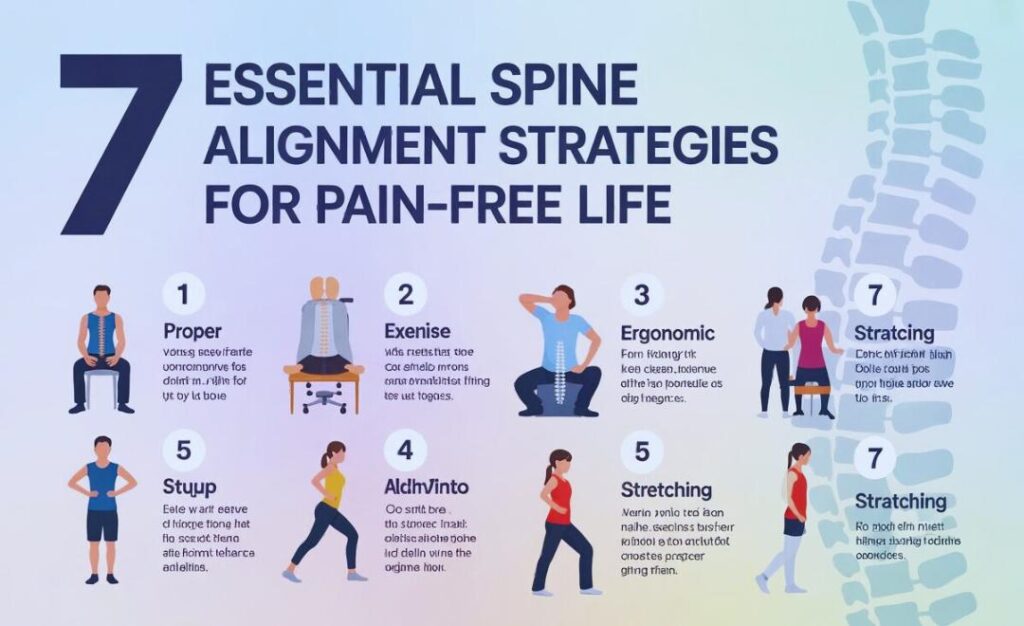
To preserve spine alignment while working:
- Hips and Knees: Keep your knees slightly lower than your hips to maintain the lumbar curve.
- Monitor Height: The top third of your screen should be at eye level. If you are looking down, you are adding up to 60 lbs of pressure to your cervical spine (the “Tech Neck” phenomenon).
- Arm Support: Your elbows should rest comfortably at 90 degrees to prevent the “shrugging” motion that causes tension headaches.
Strategy 3: The Core-Spine Connection
You cannot have permanent spine alignment without a stable core. However, “core” does not just mean six-pack abs; it refers to the deep transverse abdominis and multifidus muscles that wrap around your vertebrae.
Strengthening the “Inner Corset”
Exercises like the “Dead Bug” or “Bird-Dog” are superior to traditional crunches because they promote spine alignment while under load. By strengthening these stabilizers, you create a muscular “scaffold” that keeps your vertebrae in place even when you are tired or stressed.
Strategy 4: Decompression and Gravity Management
Gravity is the constant enemy of spine alignment. Over the course of a day, your spinal discs lose fluid and compress. This is why you are actually slightly shorter at night than in the morning.
The Power of Hanging
Daily decompression is a “cheat code” for spine alignment. Spending just 60 seconds hanging from a pull-up bar (even with your feet touching the ground) allows your discs to rehydrate. This “space” between the vertebrae relieves pressure on the spinal nerves, often providing instant relief from sciatica and lower back tightness.
Strategy 5: The Sleep-Alignment Protocol
We spend roughly 30% of our lives in bed. If your sleeping posture is poor, you are undoing all the spine alignment progress you made during the day.
Optimal Sleeping Positions
- Back Sleepers: This is the gold standard for spine alignment. Place a small pillow under your knees to maintain the lower back’s natural curve.
- Side Sleepers: Place a firm pillow between your knees to keep your pelvis square. Without it, your top leg pulls your spine into a rotation, causing morning stiffness.
- The “Stomach” Warning: Avoid sleeping on your stomach, as it forces your neck into a 90-degree turn, which is disastrous for long-term cervical spine alignment.
Strategy 6: Proprioception and Mindful Movement
Most people have “postural amnesia”—they don’t know where their body is in space. To improve spine alignment, you must retrain your brain’s connection to your muscles.
The “Wall Reset”
Perform this every two hours: Stand with your heels, glutes, shoulders, and the back of your head against a wall. Tuck your chin slightly. This “recalibrates” your brain’s perception of what straight spine alignment feels like, making it easier to maintain throughout the day.
Strategy 7: Footwear and the Kinetic Chain
Your spine starts at your feet. If your footwear is unsupportive, your ankles roll in (pronation), causing your knees to rotate and your pelvis to tilt. This “ground-up” misalignment makes consistent spine alignment impossible.
Choosing the Right Foundation
Avoid high heels or completely flat “fashion” sneakers for long-term wear. Look for shoes with a neutral arch or consider orthotic inserts. When your foundation is level, your spine alignment naturally follows.
Consultation: Personalizing Your Path to Recovery
Every spine has a unique history—old injuries, genetic predispositions, and specific work habits.
My Consultation Advice:
If you are currently in pain, do not attempt to “force” your posture. Spine alignment is a journey of release, not just effort. Start by auditing your workspace and your bed. Often, the most significant improvements come from removing the negative factors (the bad chair, the old mattress) rather than just adding new exercises. Focus on consistency; five minutes of corrective movement every day is worth more than a two-hour gym session once a week.
Summary Table: The Spine Alignment Checklist
| Strategy | Daily Action | Target Benefit |
| Ergonomics | Set monitor to eye level | Prevents “Tech Neck” |
| Stability | 10 reps of Bird-Dog | Core-Spine Support |
| Sleep | Use a knee pillow | Lumbar Protection |
| Recovery | 60-second bar hang | Disc Decompression |
Frequently Asked Questions (FAQs)
How do I know if my spine alignment is off?
Common signs include uneven shoulders, shoes wearing out more on one side, persistent headaches, and “catching” sensations in your lower back. A simple “wall test” (Strategy 6) is a great self-diagnostic tool.
Can a chiropractor permanently fix my spine alignment?
A chiropractor can restore mobility to “stuck” joints, but the muscles determine where those joints stay. Without the strengthening strategies mentioned in this guide, your spine alignment will likely revert to its old habits.
Does “cracking” my own back help with alignment?
Usually, no. When you crack your own back, you are often moving the segments that are already too mobile. The segments that actually need spine alignment are usually the stiff ones that require professional mobilization
Are standing desks always better for the spine?
Not necessarily. Standing for 8 hours can lead to “swayback” (excessive lumbar curve). The best strategy for spine alignment is a “sit-stand-move” rotation every 30 minutes
Is it ever too late to fix my posture?
Never. While structural changes take longer in older adults, the muscular and neurological components of spine alignment can be improved at any age, significantly reducing pain levels
Conclusion
Living a pain-free life is a choice made through a thousand small daily decisions. By implementing these seven spine alignment strategies, you are doing more than just standing taller; you are protecting your future mobility and mental clarity. Start today—your spine will thank you for years to come.










Leave a Comment