
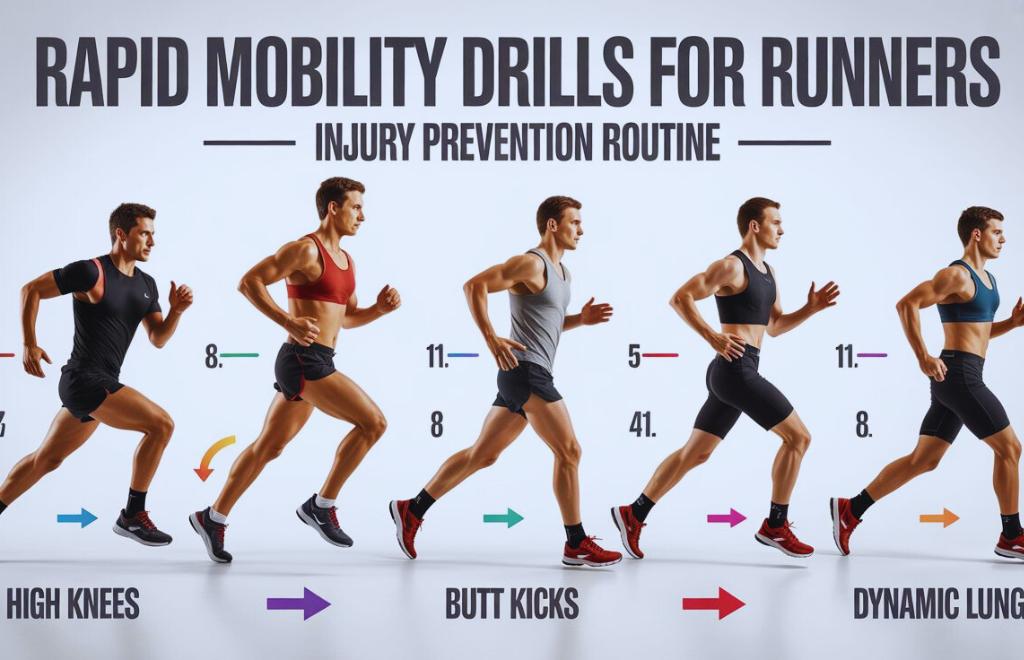
Introduction: Running is one of the most physically demanding activities the human body can endure. While it is often praised for its simplicity—requiring little more than a pair of shoes and a stretch of road—the biomechanical reality is far more complex.
Every stride sends a ground reaction force through your feet, ankles, knees, and hips that can be up to three to four times your body weight. Without proper preparation, this repetitive stress inevitably leads to the “runner’s curse”: shin splints, IT band syndrome, or the dreaded runner’s knee.
The secret to longevity in this sport isn’t just “more miles”; it is the implementation of Rapid Mobility Drills for Runners That Prevent Injury. Unlike traditional static stretching, which can actually decrease muscle power before a run, mobility training focuses on the active range of motion of your joints.
By ensuring that your ankles, hips, and thoracic spine move fluidly, you eliminate the compensations that cause injury. In this comprehensive guide, we will explore the science of mobility, the most effective drills for 2026, and how to integrate these movements into a lifestyle that keeps you on the pavement and out of the physical therapist’s office.
The Science of Mobility: Why Runners Break Down
To understand why Rapid Mobility Drills for Runners That Prevent Injury are non-negotiable, we must first distinguish between flexibility and mobility. Flexibility is the passive ability of a muscle to stretch (think: touching your toes). Mobility, however, is the ability of a joint to move actively through its intended range of motion.
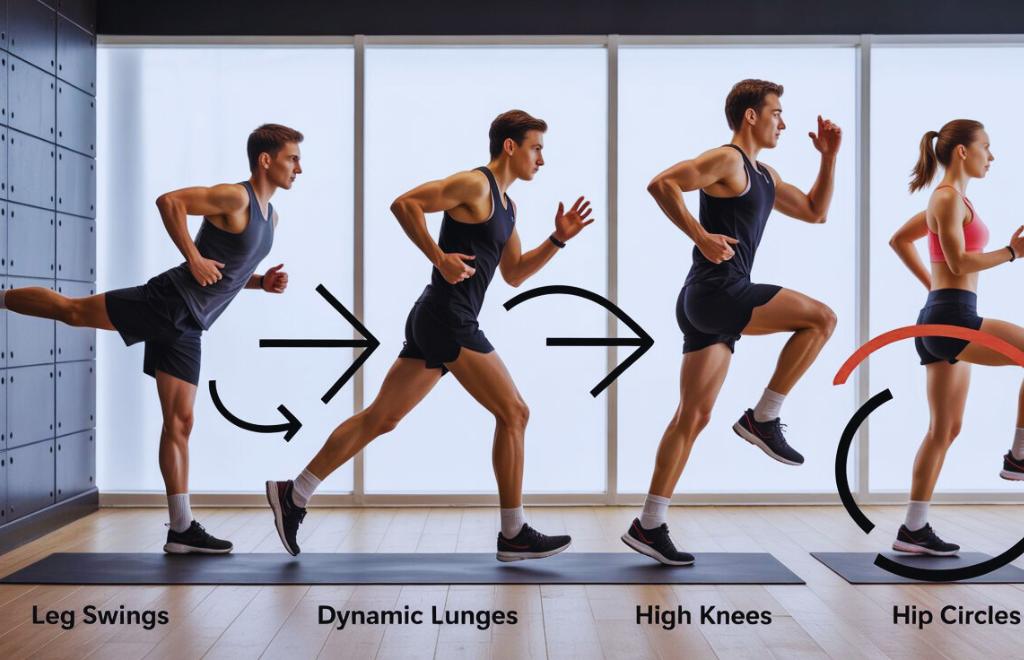
When a runner lacks mobility in one joint, the body doesn’t stop moving; it simply “borrows” that movement from somewhere else. For example, if your ankles are stiff, your knees will collapse inward to find more range, leading to ACL strain. If your hips are locked, your lower back will arch excessively to complete your stride, causing lumbar pain. Mobility drills act as a “pre-flight check,” ensuring every joint is calibrated to handle the impact of the run.+1
The Three Pillars of Running Mobility
- Ankle Dorsiflexion: Crucial for shock absorption and powerful “toe-off.”
- Hip Extension and Rotation: The engine of your stride.
- Thoracic Spine Rotation: Prevents your torso from rotating too much, which wastes energy and strains the hips.
The Ankle: The First Line of Defense
Your feet and ankles are the only points of contact with the ground. If they are rigid, the rest of your body absorbs 100% of the shock. Improving ankle mobility is the most effective way to prevent shin splints and plantar fasciitis.
Drill: The Wall Ankle Mobilizer
- How to do it: Stand facing a wall with your toes about 4 inches away. Keep your heel glued to the floor and drive your knee forward until it touches the wall.
- Why it works: This increases dorsiflexion, allowing your lower leg to move further forward over your foot. This reduces the “slapping” motion of the foot that causes shin pain.
Drill: Ankle Alphabets
- How to do it: Sit with one leg elevated. Use your big toe as a “pen” and draw the entire alphabet in the air.
- Why it works: It engages the small stabilizer muscles around the joint, improving proprioception (your brain’s awareness of where your foot is in space).
The Hips: The Powerhouse of the Stride
Most runners spend their day sitting at a desk, which leads to “shortened” hip flexors. When you try to run with tight hips, you can’t bring your leg behind you effectively, which kills your speed and strains your hamstrings.+1
Drill: The 90/90 Hip Flow
- How to do it: Sit on the floor with your right leg in front, bent at 90 degrees, and your left leg to the side, also at 90 degrees. Rotate your torso over the front leg, then switch to the other side without using your hands.
- Why it works: This targets both internal and external rotation of the hip. It unbinds the joint capsule, allowing for a smoother, longer stride.
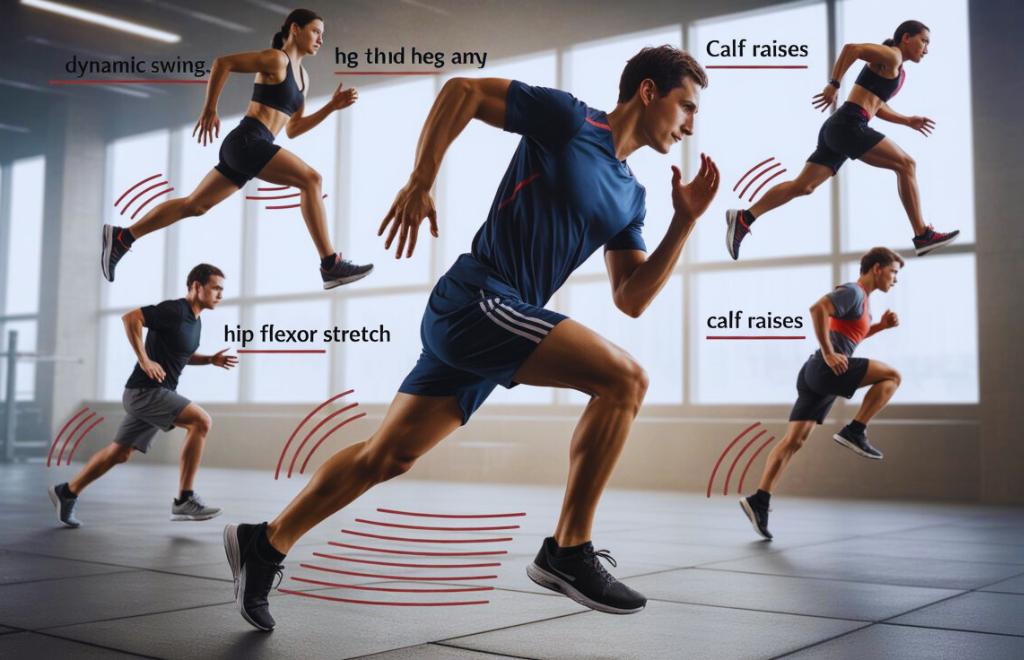
Drill: Dynamic Hip Flexor Stretch with Reach
- How to do it: Drop into a low lunge. As you push your hips forward, reach the arm on the side of the back leg up and over toward the opposite side.
- Why it works: It stretches the psoas and the lateral line of the body, which are often the primary culprits in lower back tightness for runners.
The Thoracic Spine: Breathing and Balance
Many runners ignore their upper body, but the thoracic spine (mid-back) is where your arm swing is generated. If your mid-back is stiff, your lower back has to rotate to compensate, which is a leading cause of “mystery” hip pain.+1
Drill: The Open Book
- How to do it: Reach your top arm across your body and try to touch the floor behind you while keeping your knees together.
- Why it works: It opens up the chest and restores rotation to the ribcage. This allows for better lung expansion—essential for those long-distance efforts.
The “World’s Greatest Stretch”: The All-in-One Solution
If you only have time for one of these Rapid Mobility Drills for Runners That Prevent Injury, this is it. It hits the ankles, hips, hamstrings, and thoracic spine in one fluid motion.
- Step 1: Start in a deep lunge with your hands on the floor inside your front foot.
- Step 2: Take the elbow on the side of the front leg and try to touch it to the floor.
- Step 3: Rotate that same arm up toward the ceiling, looking at your hand.
- Step 4: Push your hips back and straighten your front leg to stretch the hamstring.
Integrating Mobility Into Your Routine
Consistency is the enemy of injury. You do not need an hour of mobility work to see results. Research in 2026 suggests that 8–12 minutes of focused mobility before a run is significantly more effective than 30 minutes of stretching on a rest day.
Expert Tip: Think of mobility as “movement vitamins.” You don’t need a whole bottle at once; you just need a small, consistent dose every day to keep the system running smoothly.
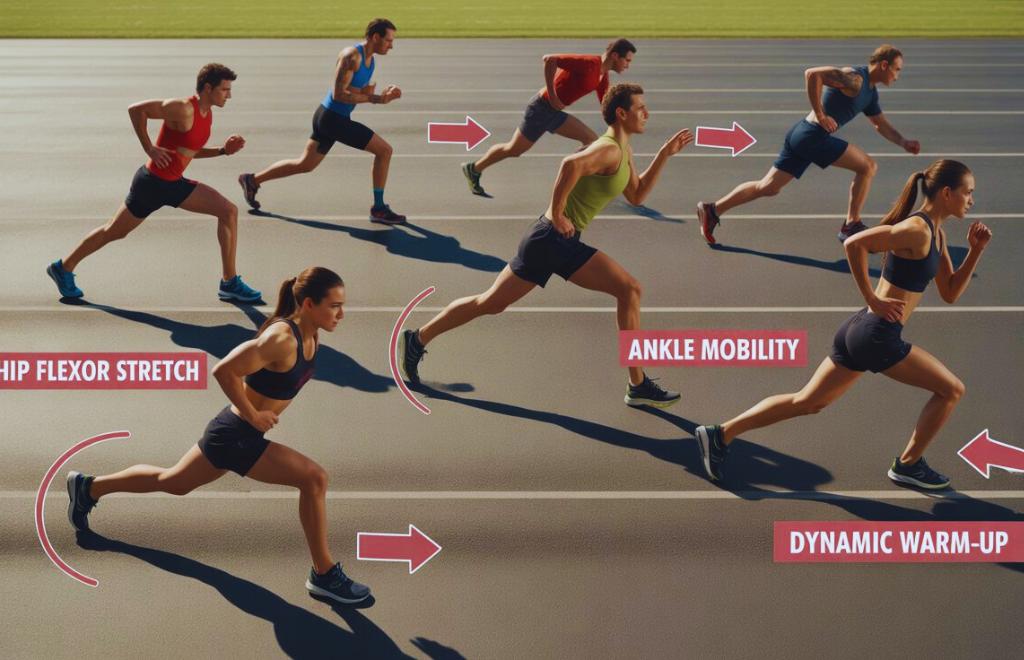
Sample Pre-Run Mobility Circuit (10 Minutes)
| Exercise | Duration/Reps | Target Area |
| Wall Ankle Mobilizer | 15 reps / side | Ankles |
| 90/90 Hip Flow | 10 reps / side | Hips |
| Leg Swings (Front/Side) | 20 reps / side | Hip Joint |
| Open Book Stretch | 10 reps / side | T-Spine |
| World’s Greatest Stretch | 5 reps / side | Total Body |
Consultation: When to Seek Professional Help
While Rapid Mobility Drills for Runners That Prevent Injury are highly effective for general maintenance, they are not a substitute for medical advice. If you experience sharp, localized pain that worsens with activity, or if your range of motion is severely limited on one side compared to the other, consult a sports-certified physical therapist. Professional gait analysis can often identify “silent” mobility gaps that even the best drills cannot fix alone.
Conclusion
Mastering Rapid Mobility Drills for Runners That Prevent Injury is the difference between a runner who is sidelined every three months and a runner who completes their first marathon feeling strong. By prioritizing the health of your joints, you are not just preventing pain—you are unlocking a more efficient, powerful version of your running self. Start today, stay consistent, and let your mobility be the foundation of your miles.
Frequently Asked Questions (FAQs)
Can I do these drills after my run instead of before?
While you can do them after, mobility drills are most effective before a run. They prime the nervous system and “wake up” the joints you are about to use. Post-run is a better time for static, relaxing stretches.+1
How long does it take to see results in my running form?
Most runners feel a “lightness” in their stride immediately after the first session. However, structural changes in joint range of motion typically take 4–6 weeks of consistent practice (3-4 times per week).
Will mobility drills make me faster?
Yes. By improving your hip extension, you can generate more power from your glutes and hamstrings. A longer, more efficient stride leads directly to faster pace times with less effort.
Can these mobility drills fix existing running injuries?
While Rapid Mobility Drills for Runners That Prevent Injury are excellent for rehabilitation, they are primarily a preventative tool. If you are experiencing sharp pain or swelling, consult a professional first. However, for chronic tightness or dull aches, these drills are often the “missing link” in a successful recovery plan.
I’m already flexible; do I still need to do mobility drills?
Absolutely. Flexibility is often “loose” and uncontrolled. Mobility is about control. Even flexible runners need to train their muscles to stabilize their joints during the high-impact phases of running to avoid ligament tears









Leave a Comment